


A.E. Housman may have been right when he declared that the cherry was the loveliest tree in springtime, but for sheer autumnal majesty the gingko tree is hard to beat. We are lucky to have a mature gingko in our front garden. Even on cloudy days, it is a glorious sight but on bright November days, its fan-shaped leaves are refulgent in gold.

Known as a ‘living fossil’ the gingko biloba is the sole survivor of the ancient order of trees, the Ginkoales, and the only species in the Ginkgoaceae family. Fossil records show that gingkos almost identical to those alive today existed over 200 million years ago, making them one of the oldest living species of plant on the planet. Rather mind-blowingly, the gingko is a gymnosperm, which means it does not produce flowers and is more closely related to conifers and ferns than to other deciduous trees. The genus name ‘gingko’ comes from the misspelling of the Japanese gin kyo meaning ‘silver apricot’ while the epithet ‘biloba’ is Latin for ‘two-lobed’.

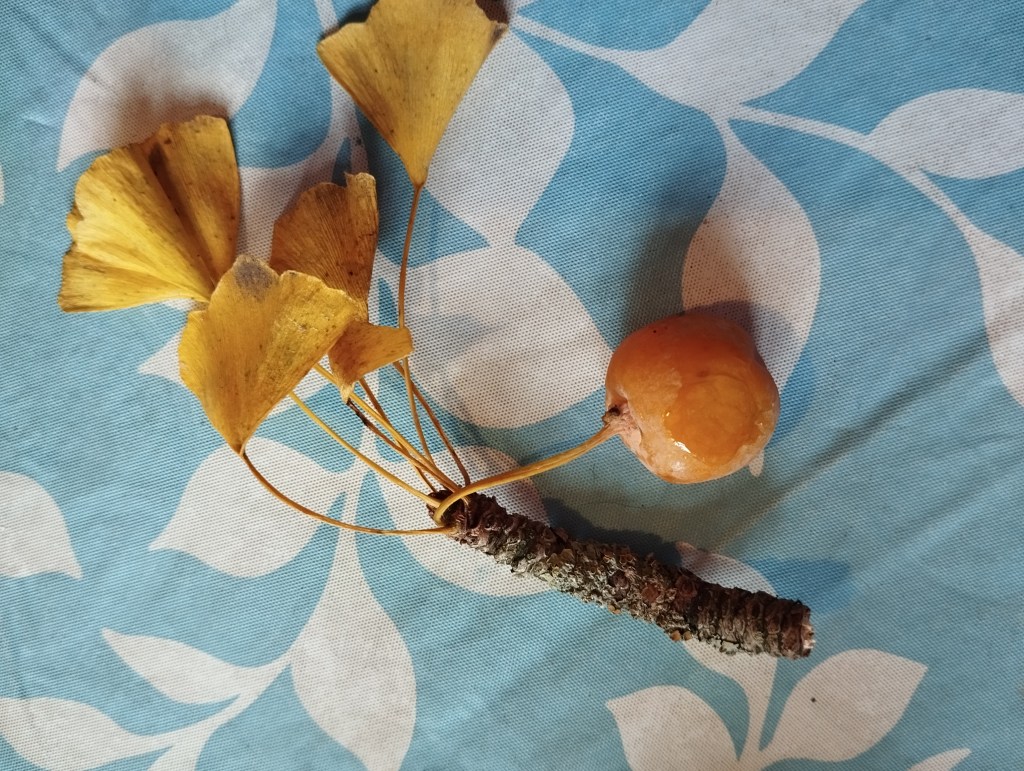
Ginkgo biloba is dioecious, which means some trees are female and others male, although some individuals have been known to change sex. Males produce pollen cones, while on female trees, ovules form at the ends of stalks, which if wind-pollinated with pollen from a male, form into fruit-like structures containing seeds. Females do not produce fruit until they are at least twenty years of age. Our tree is female and is currently laden with the soft silvery-golden fruits from which the tree gets its name. Though pretty, these fruits contain butyric acid, which gives off the unpleasant whiff of rancid butter and can irritate the skin if touched. Woodpigeons don’t appear to mind, however, judging by the mess they leave on our car bonnet.
I’m not too cross about the pigeons though. I hope to grow some baby gingkos from seed and currently have a batch of seeds stratifying in the fridge in a bag of potting medium. By eating the fruits and passing out the seeds, the pigeons have spared me the messy and smelly job of extracting the seeds from the fruits, as well as increasing the chances of germination, thanks to chemicals in their guts. (The emery board is for scarifying the seeds.)

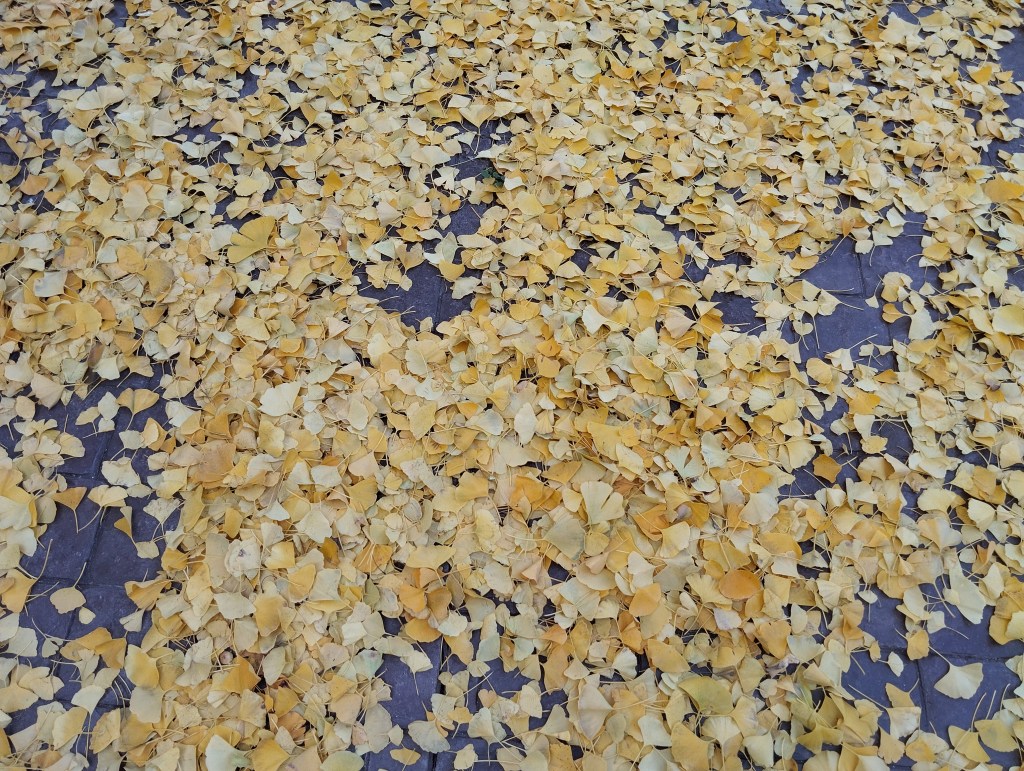
The gingko goes by the common name of ‘maidenhair tree’ because its unusual fan-shaped leaves resemble the leaflets or pinnae of maidenhair ferns. It is the only seed-bearing plant to have leaf veins that radiate outwards rather than forming a network. Our gingko is currently shedding its autumn foilage; our front drive and the alleyway next to it are fast disappearing beneath great drifts of saffron-yellow confetti. It’s hard to keep on top of the sweeping but we must do it as the leaves are tough and leathery and take much longer to decompose than those of other deciduous trees. The bark is rough, deeply fissured, and silver-grey.

Gingko bilobas were once widespread across the world, but nearly went extinct, possibly due to competition from flowering plants, and only clung on in China. They are widely cultivated as park and garden trees but are classified as Endangered in the wild by the IUCN. The oldest living gingko in the world is believed to be around 3,500 years old and is found in Western China. Ginkgos owe their longevity to their slow growth and protective chemicals that help them withstand pollution, diseases, and harsh conditions. They are so resilient that they even survived the blast from the atomic bomb dropped on Hiroshima in 1945.

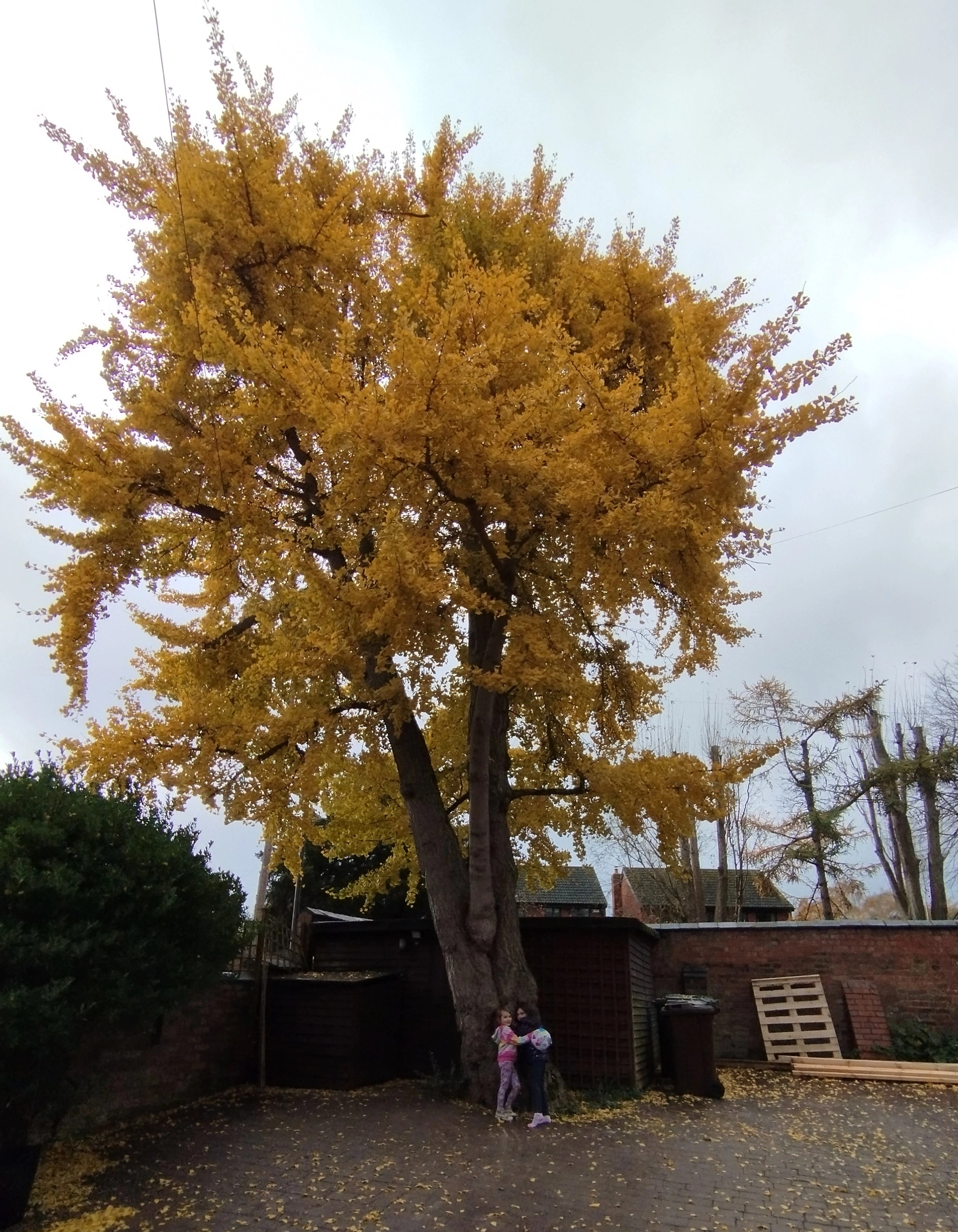
Our gingko stands around 25 metres tall with a girth of three metres. The oldest ones in China can reach heights of 50m but 25m is very tall for one on British soil. Its trunk forks about 5m above the ground and gracefully leans to one side. Its crown is a profusion of twigs, clothed in helixes of fan-shaped leaves that quiver in the wind. We don’t know how old it is but believe it to be at least 150 years old, which would make it older than our house, which was built in 1901.

Halfway through writing this blog, a strange thing happened. The doorbell rang and I answered the door to a man who told me that he just wanted to congratulate me on my magnificent gingko tree! He told me that he had recently moved back to the midlands and used to work at the Botanical Gardens in Birmingham so he knew a thing or two about trees.
Our house bears the pretty but slightly twee name of ‘Briar Cottage’ which I’m not sure suits it. Our next-door neighbours have renamed their house ‘Holm Oak House’ in honour of the mature holm oak in their garden. Perhaps we should take a leaf out of their book and rename ours ‘Ginkgo House’ or ‘The Gingko’? What do you think?

 Little Wild Tales
Hello Charlotte, it is lovely to hear from you with this post. I have a friend in the USA who has ginkgo trees along the street where he lives. The photos he publishes of ginkgos are gorgeous and now I’m seeing one in your garden. It is lovely, I especially love the shape of the leaves and I’m envious that you are hoping to grow some from seed. (I’ve only ever managed to grow oak and currently some beech, in pots for other people to grow on).
It looks like yours girls also love the tree.
Are there any briars around your house that might encourage you to keep the name?
Great to read your blog again. 🍀🙋♂️
LikeLiked by 2 people
Hello Ashley, thank you for reading it. I’ve been busy with another writing project and with being a mum of course but I intend to get back into blogging a bit more.
To be fair there are plenty of rosebushes around the house – 24 at the last count – so we could keep the name. It was just a thought.
I’ll let you know how I get on with the seeds – I’ve not had much luck with growing other tree species in the past but fingers crossed! 👋
LikeLiked by 1 person
A most interesting and fascinating article, Charlotte! I’m so glad you and your family are the ginkgo’s guardians. “A living fossil” – that’s amazing! Whoever planted it all those years ago must have been very fond of rare trees, and now you are looking after it. The photos show how beautiful it is and I’m sure your girls understand its rarity. Good luck growing the seedlings. I will be sure to look out for the ginkgos in the Birmingham Botanical Gardens!
LikeLike